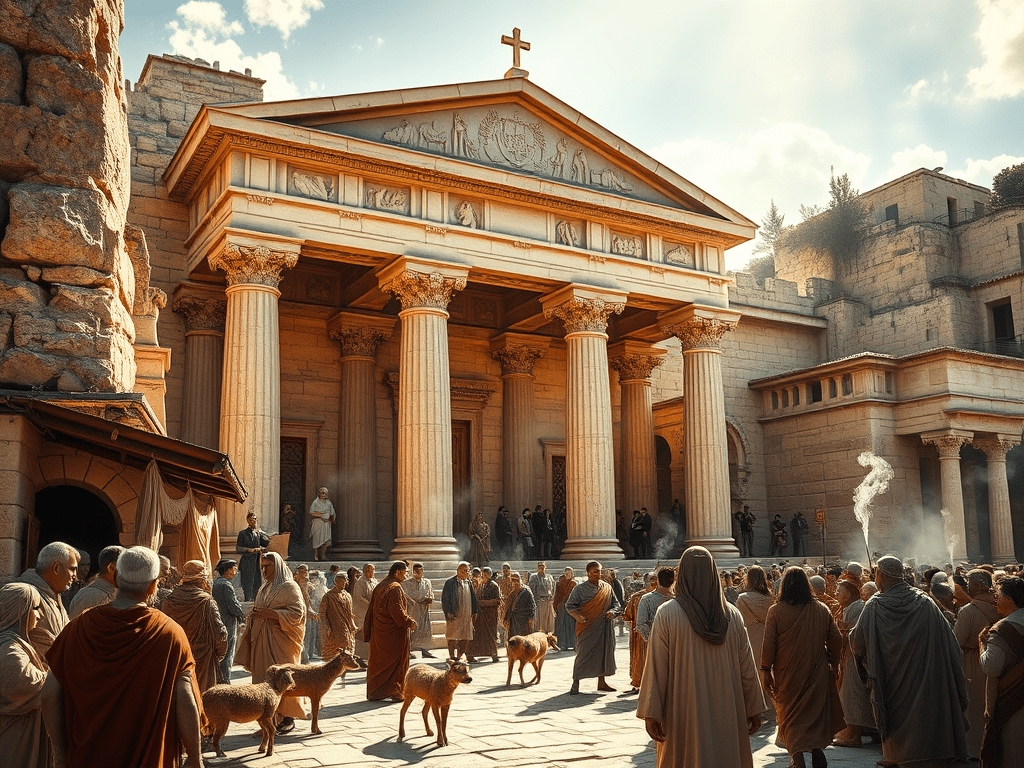
In the heart of Jerusalem stands a remnant of a past era, a great temple that was once the largest functioning religious site in the world. This temple, a marvel of architecture and devotion, took decades to build and employed tens of thousands of artisans and laborers. Within its sacred halls, Jewish worshippers engaged in ritualistic practices, cleansing themselves with purified water and seeking spiritual connection. Outside, the courtyard bustled with activity – animals were sold, money was exchanged, and the aroma of fresh sacrifices wafted through the air. It was a place where thousands gathered daily to pour out their worship, as the Levites sang and played instruments, and incense filled the air with rich fragrances.
But amidst this vibrant worship was a stark reality – a reality that angered Jesus. In the very temple that stood as a beacon of faith and devotion, Jesus witnessed the marketplace flourishing more than genuine worship. His heart broke at the sight of merchants trading with greed and the sacred space being transformed into a den of commerce. In John 2:18-19, the Jewish leaders asked Jesus for a sign to justify his actions. Jesus replied, “Destroy this temple, and I will raise it again in three days.” His words perplexed those who heard them, as they understood that he was referring to the temple of his body, foreshadowing the incredible transformation that would soon come through his resurrection.
A Reflection on Acts 2:42–47
Following his resurrection, the early followers of Christ gathered in unity at the same temple, illustrating their fervent dedication to the teachings of Jesus. Acts 2:42-47 reveals their practices: “They devoted themselves to the apostles’ teaching and to fellowship, to the breaking of bread and to prayer. Everyone was filled with awe at the many wonders and signs performed by the apostles. All the believers were together and had everything in common…” They continued to worship daily in the temple, demonstrating that, despite the temple’s past transgressions, it remained a central hub for the early Christian community to share the love and truth of Christ, right in the heart of Jewish worship.
What drives this commitment to reclaiming space for Jesus? Why would followers of Christ choose to gather at a place associated with his death and the failure of the Sadducees and Pharisees? The answer lies in their undeniable mission: to spread the message of Christ as the fulfillment of the law and prophets. The very temple that represented the old covenant became a ground where the new covenant was proclaimed.
A Mission to the People
As we delve deeper into this narrative, we must recognize the gravity of their mission. Just as Jesus and his disciples chose to go to the temple, the first Christians ventured into a space filled with those who were still seeking God. They did not shy away from the very place where opposition had thrived; instead, they walked boldly in their purpose. Acts 3 illustrates this movement: as Peter and John entered the temple, they encountered a beggar who had been crippled from birth. Through the power of the Holy Spirit, they healed him and gave him a reason to rejoice. This act not only transformed one man’s life but also showcased the tangible love of Jesus to all who witnessed it.
Today, we share a similar mission. The difference lies not in our calling to go forth, but in where we go. While the early church ventured into the temple, we often find ourselves retreating behind the walls of our churches. We gather, share our praise, and celebrate our faith within safe confines, but resembles a different kind of mission. The call Jesus placed upon us demands more than mere attendance on Sundays; it calls us to engage with the world beyond our doors.
The Call to Be the Church
Jesus didn’t die for us to simply gather; he calls us to be the church in action. This means uniting as a body of believers, not just inside our temples but out in the community, engaging with those around us. Mark 16:15 emphasizes this mission: “Go into all the world and preach the gospel to all creation.” The early believers risked their lives to bring the gospel message to the very people who sought to destroy it.
Around us, there exists a world yearning for hope and love. Our mission today is to meet those needs outside church walls, in parks, neighborhoods, offices, and online spaces. Every encounter with someone who does not know Christ is an opportunity to live out the message of love and grace. We must embrace our role as conduits of that message, crossing barriers and breaking down walls that separate us from those who need to hear it.
Staying Within Our Comfort Zones
However, today we often want to stay inside of our individual churches, nestled within the same familiar and safe walls. There is very little unity inside our churches, even our individual congregations, let alone the whole church. But that’s not where we are called to be. The Great Commission compels us not to sit idle, waiting for those outside to find their way to us. We are tasked with going and making disciples, proclaiming the gospel to every living creature.
The Holy Spirit did not descend upon the apostles by accident, nor is it bestowed upon us today for the simple pleasure of enjoying our faith in isolation. The Holy Spirit comes through baptism to empower us—not just to perform signs and wonders, but for a purpose far greater: to be witnesses for Christ and to give testimony of who He is to a world desperately in need of hope and truth.
Are You Ready to Be the Church?
So, are you ready? Are you prepared to stop merely attending church and start actively being the church? The church that goes out in unity and turns the world upside down for Christ? It’s a call to action that demands we step out in faith, understanding the gravity of our involvement in God’s mission for humanity.
No longer can we allow fear or complacency to dictate our Christian lives. Jesus modeled the heart of service and sacrifice, challenging each of us to follow suit. When we approach our communities collectively and purposefully, we become an unstoppable force of love, healing, and transformation.
Building Relationships: A New Temple
It is essential to understand that while the temple served a function in Ancient Jerusalem, today, we embody the temple of the Holy Spirit. 1 Corinthians 3:16 reminds us, “ Don’t you know that you yourselves are God’s temple and that God’s Spirit dwells in your midst?” Our mission requires us to create an environment where relationships can flourish, serving not only as a place of worship but as a bridge to those outside the faith.
Relationship building requires intentionality. In Acts 2:46-47, we read that the early church broke bread together in their homes and shared their resources with gladness. The commitment to community propelled their mission forward. It is through relationships that we can effectively share the message of Christ. When we open our tables, our lives, and our hearts, we create opportunities for real conversations that address doubt and curiosity about faith.
The early church understood the significance of living out their faith in tangible ways. The brokenness they encountered spurred them to action. Likewise, we must respond to the hollow cries of our communities, showing up not with arguments or condemnation, but with love, service, and authentic engagement.
Confronting the Marketplace
As we reignite our passion for the mission, we must also confront the modern-day marketplaces that hold many captive today. Jesus’ righteous anger at the temple’s commercialization stands as a reminder that we must protect the sanctity of our mission. Our present-day arenas of entertainment, commerce, and social media can serve dual roles – that of outreach or distraction. The question we need to wrestle with is, how are we using our platforms?
As Christians, we are called to take a stand against the systemic issues that prevent people from truly engaging with the message of Christ. We must work at the intersections of faith and society, advocating for justice, compassion, and kindness – all hallmarks of living out our mission as the church. Issues ranging from poverty, systemic racism, and societal division must not escape our notice. We must raise our voices with both faith and action to challenge these prevalent unfairnesses, speaking up where Jesus would demand it.
Conclusion: The Legacy of Proclaiming Hope
The legacy of the temple remains potent even decades later. It is reflected in our mission as the hands and feet of Christ, learning from the early believers’ commitment to gather despite their adversities. We are not just called to take refuge behind church walls. Instead, we are summoned to boldly, intentionally, and lovingly proclaim the message of hope to every person we encounter.
Let’s unite together as the church empowered by the Holy Spirit to step into the world with the same fervent spirit as the early Christians, journeying outside our walls with hearts attuned to God’s mission. Fueled by his love, we each possess the unique ability to reach the lost, the broken, and the unsure. Bridging connections, fostering genuine community, and ardently sharing our faith – these are our responsibilities as we embrace the ever-relevant call to embody the church.
In this way, we glorify our Father in heaven, continuing the work of Christ so that all may come to know the transformative love of Jesus – the one who died for our freedom and called us to be so much more than just attendees. It is time to reclaim the Great Commission in our lives by recognizing that “being the church” is our supreme calling, carried out daily, in every interaction we have in every corner of our world.
So, the question remains, are you ready to go all in? Are you willing to answer the call, step outside your comfort zone, and be part of a movement that will radically change the world for Christ? It’s time. The world is waiting. Let’s be the church that truly lives out the love of Jesus.







 Pastor Tricia's Ramblings
Leave a comment