
A Reflection on James 2:1–9
We all have favorites. Favorite colors, favorite foods, favorite songs. What are yours?
Mine? My favorite color is purple. My favorite food is ice cream. And my favorite song? That changes regularly, but right now it’s “That’s Who I Praise.” When someone asks us these kinds of questions, we can answer quickly. Personal preferences aren’t difficult to identify. They’re a normal part of our lives. They make us unique and individual.
But what happens when our personal preferences cross into something deeper—something that affects the way we see people?
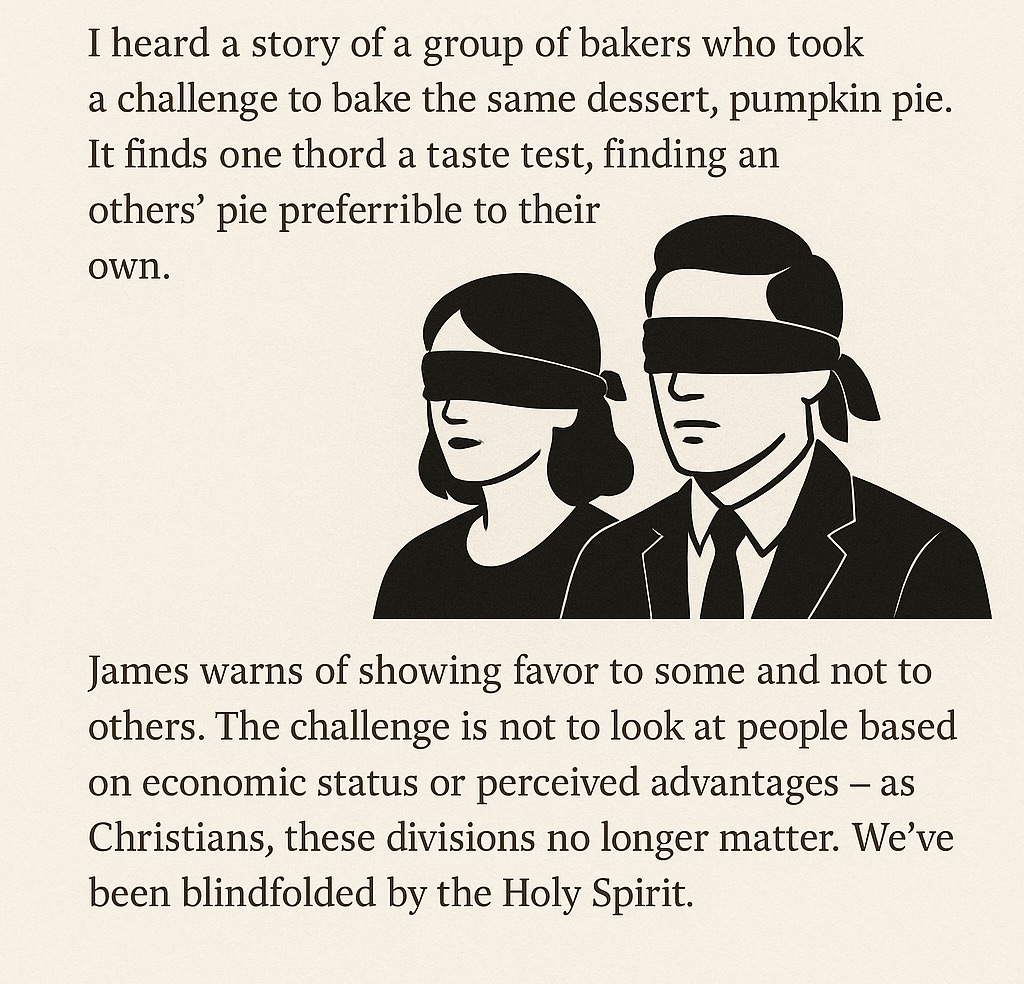
Let me tell you a story I once heard. A group of bakers decided to take on a friendly challenge. Each was tasked with baking a pumpkin pie using their own personal recipe. Once the pies were finished, they met up for a blind taste test. The pies were labeled, sliced, and served while each baker wore a blindfold so they couldn’t tell which pie was theirs. They were instructed to critique each pie based on taste, texture, and smell.
What happened next was pretty funny: not a single one of the bakers picked their own pie as the best. In fact, most were overly critical of their own. “Too sweet.” “Too bland.” “Too much spice.” “Not enough crust.” Their blindfolds had stripped away their bias. Before the test, each baker would have confidently said their pie was the best. But without knowing which pie was theirs, their preference changed.
This story makes us laugh, but it also offers a quiet challenge. We all have biases. Sometimes they’re small and harmless, like food preferences. But other times, our biases can affect how we treat people—especially when we judge them based on what they wear, where they live, what they drive, or how they talk.
James, the brother of Jesus, gets straight to the point about this issue. In James 2:1–9, he calls out favoritism in the church and exposes how it contradicts the gospel we claim to believe.
James writes:
“My brothers and sisters, do not show favoritism as you hold on to the faith in our glorious Lord Jesus Christ. For if someone comes into your meeting wearing a gold ring and dressed in fine clothes, and a poor person dressed in filthy clothes also comes in, if you look with favor on the one wearing the fine clothes and say, ‘Sit here in a good place,’ and yet you say to the poor person, ‘Stand over there,’ or ‘Sit here on the floor by my footstool,’ haven’t you made distinctions among yourselves and become judges with evil thoughts?” (James 2:1–4, CSB)
It’s a piercing question: Haven’t you made distinctions?
Of course we have. We all have. But James isn’t talking about innocent personal preferences. He’s talking about spiritual hypocrisy. The kind that treats some people better than others based on superficial, earthly factors like wealth, status, or influence.
James is warning us that when we play favorites, we’re operating out of a value system that isn’t God’s.
Let’s be honest: in the Western church, this message is hard to swallow. We live in a culture that is obsessed with success, status, and image. That mindset often seeps into our churches. We greet the people who look like us. We sit next to those who make us comfortable. We gravitate toward the well-dressed, the confident, the polished, and the popular.
But if someone comes in disheveled, awkward, mentally ill, or visibly poor, we instinctively pull back—or we look right past them altogether. We may not say, “Sit on the floor,” but we may say nothing at all. Our silence becomes exclusion. Our comfort becomes preference. And that’s exactly what James is calling out.
He says this kind of behavior is more than unkind—it’s sinful. It goes against everything Jesus taught. It makes us “judges with evil thoughts.” Strong words, right? But James isn’t mincing them. He’s trying to wake us up.
James goes on to say in verse 5:
“Listen, my dear brothers and sisters: Didn’t God choose the poor in this world to be rich in faith and heirs of the kingdom that he has promised to those who love him?”
God’s value system is completely upside-down from ours. While we’re drawn to success, beauty, power, and status, God is drawn to the humble, the broken, the unseen. He chooses the ones society overlooks. He chooses the poor in spirit and the poor in pocket. He says they are rich in faith.
And yet… many of our churches function like exclusive clubs. We highlight the influencers, praise the professionals, and seat the wealthy on our leadership boards. We often forget the ones God never forgets.
Let’s go back to the blindfolded bakers for a moment. When they couldn’t see which pie was theirs, their bias was removed. Their judgment became more objective. Now imagine if we could walk through life wearing spiritual blindfolds—not blind to people’s humanity, but blind to their status. What if we were able to look past the surface and see people for who they truly are: beloved children of God?
As Christians, this is exactly what we are called to do. James isn’t asking us to try harder to be nice. He’s telling us that favoritism has no place in a life of faith. If we truly believe in Jesus—the one who ate with sinners, touched lepers, and welcomed the forgotten—then our lives must reflect that.
James reminds us that when we fail to love impartially, we violate the “royal law” of Scripture: “Love your neighbor as yourself” (James 2:8). If we pick and choose who deserves love, we’re no longer loving like Jesus.
So let’s ask some hard questions:
- Do I make room in my life for people who are difficult, different, or needy?
- Have I allowed wealth or appearance to influence how I treat someone?
- Am I more impressed by worldly success than by spiritual depth?
- Do I view the poor and marginalized as burdens or as blessings?
These are questions that demand honest answers. They force us to examine not just our behavior but our hearts.
One of the most powerful things James says is found in verse 9:
“But if you show favoritism, you commit sin and are convicted by the law as transgressors.”
Let that sink in. Favoritism isn’t a flaw. It’s not a weakness. It’s sin.
And like all sin, it must be confessed and repented of. God’s grace is big enough to forgive us and transform us. But transformation won’t happen unless we’re willing to name the problem. And favoritism is a problem.
Think about the church culture you’re part of. Would someone who is poor feel welcome there? Would someone who is mentally ill be cared for? Would someone who struggles socially be embraced? Would someone with no money, no influence, and no charisma be given a seat at the table?
If not, we have work to do.
The gospel is not about status. It’s not about power. It’s not about who’s most gifted or most well-dressed or most impressive. The gospel is about Jesus, who gave up His own status and took on our shame to redeem us all—rich and poor, powerful and powerless, together.
We need to remember that the people we’re most likely to overlook are often the very people God is using to reflect His heart. James said earlier in chapter 1 that true religion is to care for widows and orphans and to remain unstained by the world. And favoritism? That’s a stain. It’s a worldly lens. It distorts how we see others.
But we are not called to live by the world’s standards. We are called to see with God’s eyes. To love without partiality. To welcome without hesitation. To serve without calculating someone’s worth.
So, who are the “have-nots” in your life? Who are the ones who seem to always be in need? Have you made room in your heart for them? Or have you kept your distance, consciously or unconsciously, because they didn’t bring enough to the table?
Let’s be honest—we like people who make our lives easier. But the gospel calls us to love people who make our lives harder. Not out of guilt, but out of the recognition that we were once outsiders too. Jesus didn’t save us because we were impressive. He saved us because He loved us.
And now, He asks us to love others the same way.
This is where James challenges the Western Christian mindset. We like neat categories. We like our church services to be comfortable. We like to worship alongside people who look like us and think like us. But God is not interested in comfort. He’s interested in transformation. And that means inviting in the broken, the needy, the outsider—and loving them well.
There’s a line in James 2 that I keep coming back to: “Have you not discriminated among yourselves and become judges with evil thoughts?”
We are not called to be judges. We are called to be servants. We are not called to assign value to people. We are called to see the value God already placed in them.
So today, take a step back. Examine your heart. Look at the circles you move in. Ask yourself: Is there room at my table for someone who has nothing to offer me?
Because that’s exactly the kind of person Jesus made room for.
And if we’re going to follow Him, we must do the same.







 Pastor Tricia's Ramblings
Leave a comment