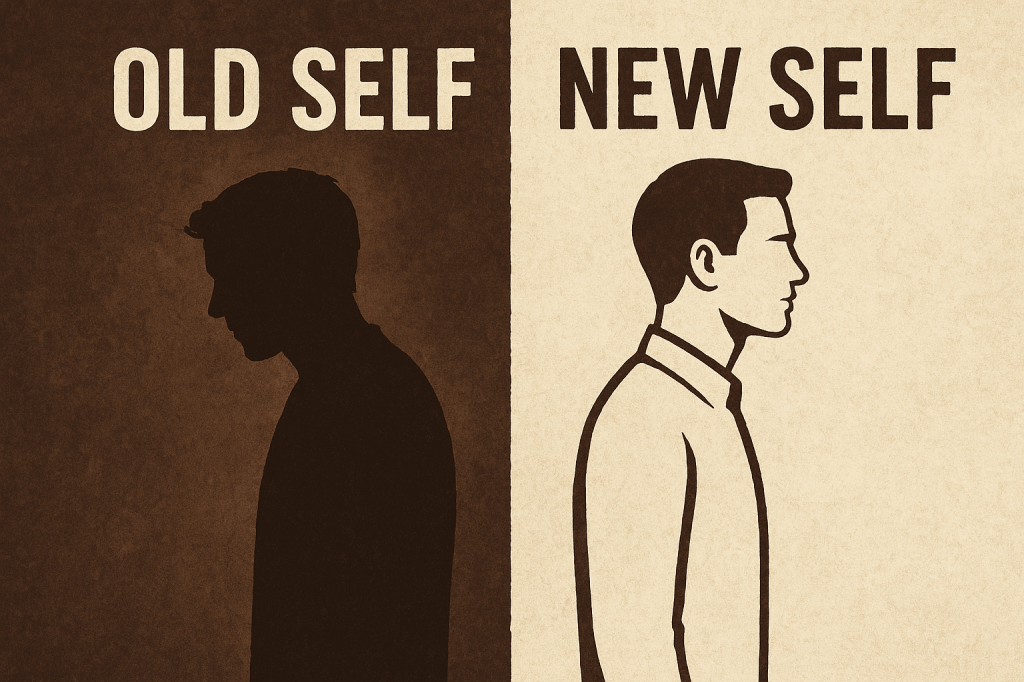
(Based on Colossians 3:1–11)
When I came to Christ, everything about me changed. My very nature shifted. I am not who I was. That “me” is dead and gone. But if you’re like me, you’ve probably realized that letting go of the old self doesn’t happen overnight. It’s a daily choice, a process of learning to put away what once defined us so that we can walk in who Christ says we are.
Paul reminds us in Colossians 3:1–2:
“Since, then, you have been raised with Christ, set your hearts on things above, where Christ is, seated at the right hand of God. Set your minds on things above, not on earthly things.”
That’s where it starts—what we set our minds on determines what we live for.
A New Identity, Not Just a New Habit
The Christian life isn’t about adding a few spiritual habits onto our old way of living. It’s about a total transformation. Paul says in verse 3: “For you died, and your life is now hidden with Christ in God.”
That means the old self is gone. Dead. Buried. And yet, how many of us still carry around parts of that old self like a backpack full of bricks? We replay old habits, old sins, old ways of thinking—even though Christ has set us free from them.
Think about it: if someone is released from prison but chooses to keep wearing the orange jumpsuit, something is wrong. In the same way, when we come to Christ, we’re no longer defined by sin, shame, or selfish ambition. The old identity doesn’t fit anymore.
What We Live For Determines How We Live
Every one of us is living for something. Some people live for success, others for approval, comfort, or pleasure. But Paul makes it clear—what you live for shapes every decision you make.
If your deepest desire is to honor Christ, that will affect how you spend your time, your money, and your energy. It will affect how you treat your family, how you work at your job, and even what you choose to watch or scroll through on your phone.
This isn’t legalism—it’s love. It’s honor. It’s holiness. We don’t live for Christ to earn His love; we live for Him because we already have His love. Paul reminds us in Ephesians 2:8–10 that salvation is by grace, not by works. We work from our salvation, not for it.
Modern Examples of Living for Christ
Let’s make this practical.
- In your workplace: maybe you have the chance to cut corners to get ahead, or shade the truth to make yourself look better in a report. If your identity is rooted in self-promotion, you’ll probably do it. But if your life is hidden in Christ, integrity matters more than advancement. You’d rather honor Him than build your résumé.
- In your family: when frustrations rise at home—kids disobey, a spouse says something hurtful, or a relative tests your patience—you have a choice. Do you react in anger (the old self) or respond in grace (the new self)? Colossians 3:13 says, “Bear with each other and forgive one another if any of you has a grievance against someone. Forgive as the Lord forgave you.”
- On social media: we live in a culture of likes, follows, and shares. But when your life is hidden in Christ, those numbers stop defining you. Suddenly the question shifts: Did this post point people to Jesus? That becomes more important than how many people noticed.
- With your money: the old self says, “Spend it all on yourself. Build your dream life.” The new self asks, “How can I use what God gave me to bless others?” Jesus said in Matthew 6:21, “For where your treasure is, there your heart will be also.”
Every choice—big or small—flows out of what we live for.
The Danger of Self-Promotion
Have you ever met someone who claims they want to make an impact for Christ—but everything they do points people to themselves? Their name, their brand, their platform, their church. Instead of magnifying Jesus, they magnify their own influence.
Paul warns us in Colossians 3:5 to put to death whatever belongs to the earthly nature. Self-promotion may look spiritual on the surface, but at its root it’s about building our own kingdom. Jesus said in Matthew 6:24 that we cannot serve two masters. We either live to exalt Christ or to exalt ourselves.
Putting Sin to Death
Paul doesn’t sugarcoat it:
“Put to death, therefore, whatever belongs to your earthly nature…” (Col. 3:5)
That’s strong language. He doesn’t say, “Manage your sin” or “Keep it under control.” He says, “Kill it.”
Why? Because sin is not about discovery—it’s about destruction. Left unchecked, it ruins relationships, corrupts our witness, and hardens our hearts toward God.
But here’s the good news: if Paul tells us to put sin to death, it means we can. Not in our own strength, but through Christ in us. First Corinthians 10:13 reminds us that God always provides a way out of temptation.
Being Proactive Against Temptation
Overcoming sin requires more than willpower—it requires wisdom. Paul tells us to “put away” certain behaviors, which means we actively choose to avoid situations that make us vulnerable.
- If alcohol is a struggle → don’t hang out in places where it flows freely.
- If purity is a struggle → avoid being alone in compromising situations.
- If social media pulls you down → audit what you post, who you follow, and what you consume.
And don’t do it alone. Have an accountability partner—someone who loves you enough to call you out and remind you of who you are in Christ. Proverbs 27:17 says, “As iron sharpens iron, so one person sharpens another.”
One young man I know put strict filters on his devices and gave the password to a trusted friend. Why? Because he wanted holiness more than hiddenness. That’s what putting sin to death looks like—choosing boundaries that protect your soul.
Renewed Day by Day
Paul continues in verses 9–10:
“Do not lie to each other, since you have taken off your old self with its practices and have put on the new self, which is being renewed in knowledge in the image of its Creator.”
The new self isn’t a one-time switch; it’s a daily renewal. Each day we choose to walk in the Spirit (Galatians 5:16) instead of slipping back into the flesh. Each day we decide whether to cling to the old ways or to step into the new.
It’s like changing clothes. You can’t wear your dirty, torn-up outfit and your brand-new one at the same time. You’ve got to take one off to put the other on. The question is: which self are you putting on today?
Living Like Who You Are
At the end of the day, it comes down to this: are you living like who you were, or like who you are?
Who you were was trapped in sin, chasing after empty desires, bound by guilt and shame.
Who you are is chosen, forgiven, and alive in Christ—being made new, day by day, into His image.
That’s the invitation Paul lays before us in Colossians 3. Don’t settle for the old self that no longer defines you. Walk in the new identity you’ve been given.
A Daily Choice
So today, ask yourself:
- Does what I’m doing honor Christ?
- Am I living for His glory or my own?
- Am I putting sin to death or letting it creep back in?
Colossians 3:11 ends this section with a powerful reminder: “Christ is all, and is in all.” At the center of it all is Christ—our hope, our life, our identity.
So live like who you are: dead to the old, alive in Him.




 Pastor Tricia's Ramblings
Leave a comment