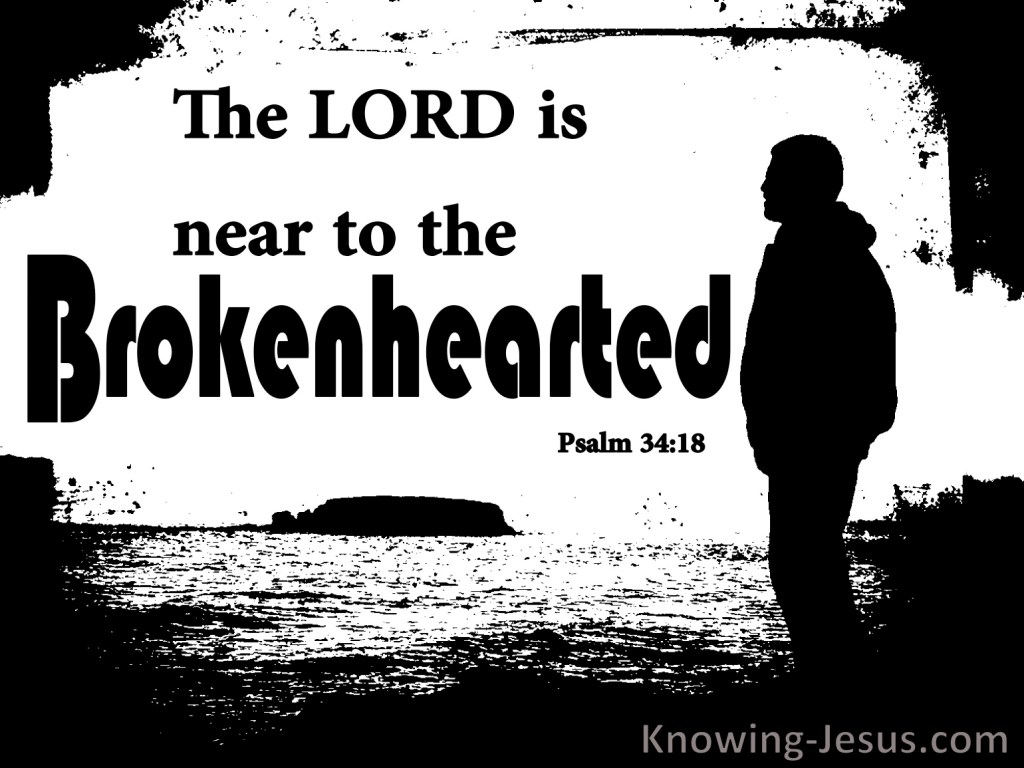
“Adonai is near those with broken hearts; He saves those whose spirit is crushed.”
— Psalm 34:18 (Complete Jewish Bible)
This morning I sat with the Hebrew text behind the phrase broken heart —
לְנִשְׁבְּרֵי־לֵב (lenishberei lev).
Our English translations render it “brokenhearted,” and that is an accurate translation. But like many Hebrew expressions, accuracy does not always equal fullness. Hebrew carries a range of meaning that English often narrows to a single word. And sometimes, in narrowing it, we unintentionally narrow what the Spirit might be saying.
The word translated “broken” comes from the root shavar (שָׁבַר). It can mean shattered, crushed, or broken. But it can also carry the sense of breaking open. In certain contexts, it can even suggest the idea of breakthrough.
At the beginning of the word in Psalm 34:18 is the letter lamed, functioning as a preposition meaning “to” or “for.” Following that is the nun, indicating the niphal stem — a reflexive or passive form. In other words, this is not merely something done externally; there is a sense of something happening within.
When we read it with that broader range in mind, the verse begins to breathe differently.
What if this passage is not only about hearts that are shattered… but hearts that are being broken open?
What if the Lord draws near not only to those who feel crushed, but to those in the middle of holy disruption?
We tend to interpret “broken heart” through a Western lens — emotional injury, disappointment, betrayal, grief. And yes, it certainly includes those experiences. But the Hebrew allows for something more layered.
A broken heart can be the place where idols fracture.
David knew that kind of breaking. When his heart chased after lust, power, wealth, or approval, the consequences shattered him. But that shattering was not the end of his story. It was the breaking open that allowed him to return.
David’s pain often became his doorway to intimacy. His psalms were not written from polished platforms, but from caves, failures, and repentance. He understood that sometimes the breaking is mercy.
A heart that has never been broken open can remain guarded, proud, self-reliant. But a heart that has been shattered by disappointment, exposed by sin, or humbled by loss becomes tender ground.
And tender ground is where God draws near.
Psalm 34 does not say the Lord is near to the strong, the self-sufficient, or the unshaken. It says He is near to the broken. He saves the crushed in spirit.
There is no anger in that nearness.
No condemnation in that saving.
Only proximity.
Sometimes the very thing that feels like it is undoing us is actually undoing what stood between us and deeper intimacy with the Father.
A broken heart may be the setup for breakthrough.
The question is not whether your heart will be broken at some point — it will. The question is what you will do with it.
Will you numb it?
Blame someone?
Build walls around it?
Or will you hand it back to the One who draws near?
He understands brokenness. He has endured rejection. He knows what it is to be grieved by those He loves. And yet He does not withdraw. He moves closer.
What was meant to break you may become the very place where God breaks through to you.
And sometimes, that kind of breaking is not destruction.
It is invitation.
Reflection: Where Is Your Heart Being Broken Open?
Take a moment and sit with this:
Where in your life right now does something feel shattered?
Is there a disappointment you didn’t see coming?
An unanswered prayer?
A relationship strain?
A place where God is exposing something in you that you would rather keep hidden?
Instead of asking, “Why is this happening to me?”
What if you asked, “What is God breaking open in me?”
Is there an idol quietly cracking?
Is there pride being softened?
Is there self-reliance giving way to deeper dependence?
The Lord is not near only when you feel strong.
He is near in the fracture.
Sit in silence for a moment and invite Him:
“Father, if this breaking is an invitation, show me what You are opening.
If this pain is preparing the soil of my heart, teach me how to receive it.
Draw near to me in this place.”
Sometimes breakthrough doesn’t look like fireworks.
Sometimes it looks like surrender.
And surrender, though it feels like loss, is often the doorway to intimacy.
Where might your broken heart be becoming holy ground?




 Pastor Tricia's Ramblings
Leave a comment